
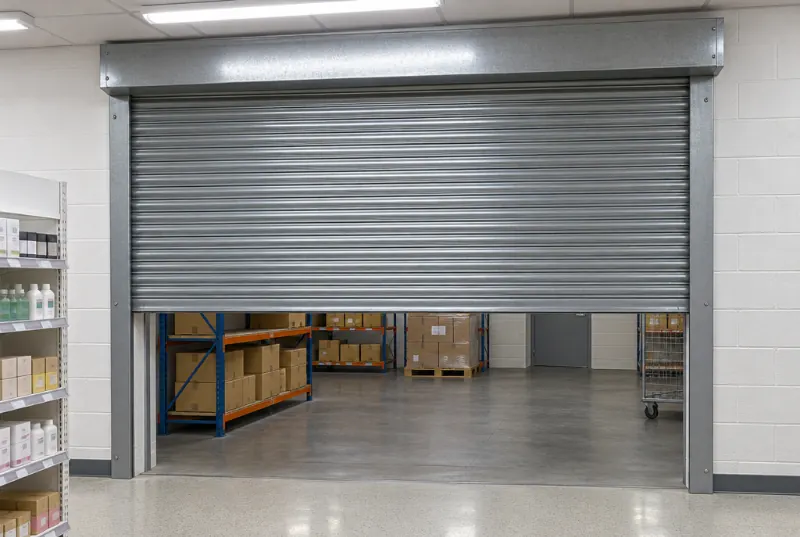
When it closes, it holds back flames and hot gases at the opening for its tested time, but it does not usually stop radiant heat unless insulated, and it is not a substitute for a tested security shutter against forced entry.
What is a fire-rated shutter and how does it differ from a security shutter?
A fire-rated shutter is a roller shutter built and tested to hold back fire for a stated time. A security shutter is built to resist forced entry. The two jobs are different, and a fire shutter is not automatically strong against an attack. If you need both, we plan them as separate requirements.
Fire shutters are tested to BS EN 1634-1, or to BS 476-22 on many existing products. Approved Document B stops recognising BS 476 fire resistance classes for new work from 2 September 2029, subject to transitional rules, so ask for the BS EN classification on anything new. Fire resistance is given in minutes, such as E 60 or E 120, where E is integrity. EW adds a limit on radiated heat, and EI adds insulation. A plain E-rated shutter does not usually stop radiant heat. Read the fire-rated shutters guide.
For security, see high-security shutters.
How much do fire-rated shutters cost?
Fire-rated shutters start from £3,840 inc VAT (£3,200 plus VAT) and run to about £10,194 inc VAT (£8,495 plus VAT) for a typical opening. These are guides until the survey, because the required rating, size and control system set the final figure.
| What moves the price | Effect |
|---|---|
| Fire rating | A longer rating needs a more substantial product |
| Opening size | Larger openings need heavier curtains |
| Closing method | Fusible link, alarm release or controlled descent |
| Insulation | An insulated product costs more than integrity only |
| Fire alarm link | Connection to the alarm panel adds electrical work |
| Motor | Any motor is itemised on the quotation |
See the price guide for how the ranges are built.
How does a fire shutter close, and which spec choices matter?
A fire shutter closes by gravity or a controlled descent device when a fusible link melts or an alarm signal releases it. The release is the safety feature. A shutter that does not close when needed has failed at its main job.
The spec choices that matter are the fire rating in minutes, the closing method, whether the shutter has insulation, the guides and the fixings. Ask for the test evidence for the product, showing the standard and the rating, and check it matches the fire strategy for the building.
Where the shutter protects an escape route, people must still be able to leave. That is a fire strategy question for your designer or fire risk assessor, and we plan the opening around it. The shutter must also be installed as tested, with the fixings and surrounding construction the test covered.
What rules apply to a fire shutter?
The Regulatory Reform (Fire Safety) Order 2005 makes the responsible person for a non-domestic building responsible for fire safety, including keeping fire protection in working order. Approved Document B sets out the guidance for new building work, and your building control body and fire risk assessor decide what the building needs.
A shutter that closes automatically is also a powered door at work. The Workplace (Health, Safety and Welfare) Regulations 1992 cover powered doors. BS EN 13241 is the product standard and BS EN 12453 covers safety in use, though HSE does not treat that standard alone as proof of compliance.
Planning may also apply to an external fire shutter. Councils commonly treat external shutters as a change to how a building looks, and your council decides for your site. Internal fire shutters usually do not need it. Work that affects a listed building's character needs listed building consent.
What happens at the survey and the fitting?
Surveys for new fire shutter installations are free. We ask for the fire strategy or risk assessment, measure the opening, check what the wall is made of and note where the alarm panel or detectors are. The required rating comes from your fire strategy, not from us.
Then you get an itemised written quotation, valid for 90 days. Nothing is ordered before you accept it. Installation is then arranged at a time that suits your building.
Fitting follows the manufacturer's method. After installation, the release is tested and the closing is checked. Keep the test evidence and the installation record with your fire safety records. S&K Glazing Limited holds the contract with you, and installers we appoint working under it may do the fitting.
How do you look after a fire-rated shutter?
A fire shutter must work on the day it is needed, so it needs regular testing and inspection. Keep the opening clear, because stock or equipment in the closing path stops the curtain. Do not paint or fix anything to the curtain, link or guides without checking first.
The responsible person under the Fire Safety Order is responsible for keeping fire protection maintained. Agree the testing routine with your fire risk assessor and keep a log of every test. Do not leave a fusible link damaged or a release disabled.
A service is a paid visit at £174 inc VAT (£145 plus VAT) per shutter, covering the service and safety check only. Repairs are quoted after inspection. See shutter repairs.
Which options can you choose?
| Option | What it means |
|---|---|
| Fire rating | Integrity in minutes, such as E 60 or E 120, as set by your fire strategy. |
| Insulation | Integrity only (E), integrity with a limit on radiated heat (EW), or an insulated product (EI). |
| Closing method | Fusible link, alarm release or controlled descent device. |
| Alarm link | Connection to the fire alarm panel so the shutter closes on signal. |
| Guides and fixings | Installed to the tested detail, in a wall that matches the test. |
Common questions
How much does a fire-rated shutter cost?
Fire-rated shutters start from £3,840 inc VAT (£3,200 plus VAT), with a guide range up to £10,194 inc VAT (£8,495 plus VAT). The required rating, size and alarm link decide the final figure, and any motor is itemised on the quotation. The exact figure arrives in writing after the free survey.
How is a fire shutter tested?
Fire shutters are tested to BS EN 1634-1, or to BS 476-22 on many existing products. The result is a fire resistance in minutes, such as E 60, EW 60 or EI 60. Ask for the BS EN classification on anything new, and for the test evidence for the exact product and opening size.
What happens to a fire shutter in a power cut?
It should close or stay closed by design. Fire shutters close by gravity or a controlled descent device when an alarm or fusible link triggers them, so they do not rely on mains power. Ask us how your chosen product behaves.
Does a fire shutter stop heat as well as flames?
Not usually. A plain fire shutter holds back flames and hot gases, but it does not typically limit radiant heat unless it carries an EW or EI classification. Your fire strategy decides which you need. Ask your assessor which applies.
Do I need planning permission for a fire shutter?
Possibly, if it is external. Expect your council to ask for an application, since an external shutter changes the building's appearance, though the decision is its own. Internal fire shutters usually need none. If the work affects a listed building's character, it needs listed building consent, and building control may be involved too.
Who is responsible for testing it?
The responsible person for the building under the Regulatory Reform (Fire Safety) Order 2005. Agree a testing routine with your fire risk assessor and keep a log. Servicing is a paid visit, and repairs are quoted after inspection.


