
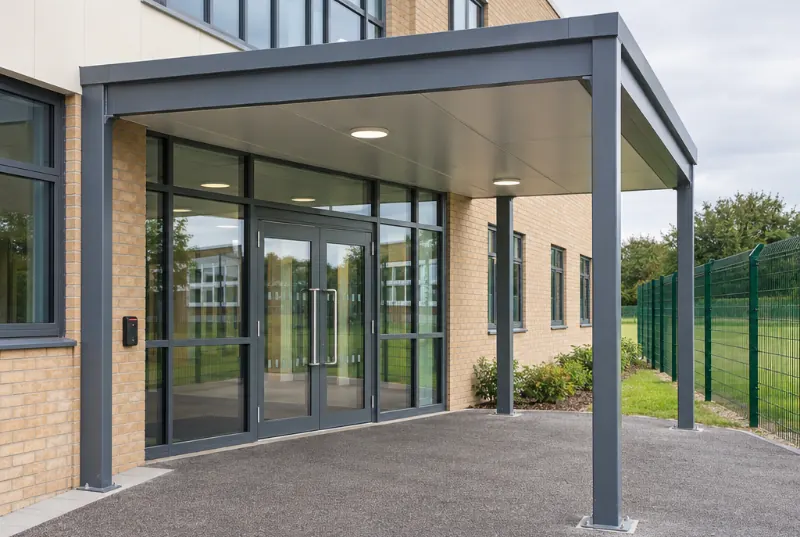
Schools and public buildings are usually affected by vandalism, forced entry and fire setting, often at ground-floor windows, rear doors and quiet external corners. Large sites have many openings and long boundaries. Buildings left unattended in holidays and evenings give people time to try several points.
What usually suits this kind of premises, layer by layer?
| Layer | What usually suits |
|---|---|
| Bollards and barriers | Use bollards to keep vehicles off paths, entrances and playground edges, and to protect glazed entrances. A site risk assessment should say where crash-rated products are needed and where standard bollards will do. |
| Shutter or grille | Grilles and shutters suit ground-floor windows, kitchens, stores and areas hit by repeated vandalism. Perforated types and open grilles keep light and ventilation, and a powder-coated finish is easier to clean. |
| Glazing and frame | Laminated glass resists forced entry and, because it holds together when struck, reduces injury from broken glass. Frames must be strong enough to take impact and heavy daily use. |
| Doors and locks | Choose doors and frames built for heavy use, with locks that can be secured from inside as well as outside. Escape routes must stay clear and open without a key. |
| Access control | Controlled entry at the main entrance and staff doors lets you manage visitors and withdraw access quickly. Release on the fire alarm is required on escape routes, and records may be personal data. |
How do you protect a school from forced entry and vandalism?
Protect the openings that are repeatedly targeted first, and use materials that are hard to damage and easy to clean. Ground-floor windows, kitchens, stores and rear doors are the usual targets, and they are often out of sight of the road.
A security grille or shutter in front of a vulnerable window shields the glass from stones and tools. A powder-coated finish resists graffiti and is easier to clean, as our graffiti and vandalism guide explains. Your trust or authority may set its own specification, and we price to it where you provide one. Planning rules for external changes still apply, and the council decides.
How do you control visitors at a school entrance?
Control the entrance with a lockable door, a visitor reception and an entry system that staff can operate without leaving their desk. A door entry panel, a fob reader for staff and a clear sightline to the entrance are the usual parts.
Safeguarding policy sits with the school, and the security system supports it rather than replacing it. Every door on an escape route must open from inside without a key and release when the fire alarm sounds, and the school's fire risk assessment should confirm the arrangement. Records from the system can be personal data, so keep them to what you need. See access control and security doors.
Can security be added to a public building without changing its look?
Often, yes, by choosing internal shutters, concealed fixings and finishes that suit the building. Public buildings are often in conservation areas or listed, and the council expects changes to respect the character of the building.
Internal shutters behind the glass usually do not need planning permission, but external ones commonly do, and listed buildings need listed building consent for work that affects their character. The council decides in each case. We note these points at the survey and raise them before any order. Our guide to listed building shopfronts and planning sets out what usually applies, and an internal counter shutter is a quieter option for reception and kiosk windows.
Common questions
Do schools need shutters?
Not as a rule. Many use laminated glazing, strong doors and controlled entry. Shutters or grilles are added at ground-floor windows, kitchens and stores that have been targeted, where forced entry or vandalism is a repeated problem.
Can security glazing reduce broken-glass injuries?
Laminated glass holds together when it cracks, so there are fewer loose shards than with ordinary glass. Toughened glass breaks into small pieces instead. Laminated glass is the choice where both security and safety matter in a school.
Do schools need planning permission for external shutters?
External shutters usually count as a material alteration to how a building looks, so the council commonly expects planning permission. Internal shutters behind the glass usually do not. The council decides, so ask before ordering.
Can we work during school holidays?
Yes. We fit around your trading hours, which for a school means agreeing dates with you. Larger jobs are often planned for holidays, so that noise and site access do not disturb pupils or staff.


