
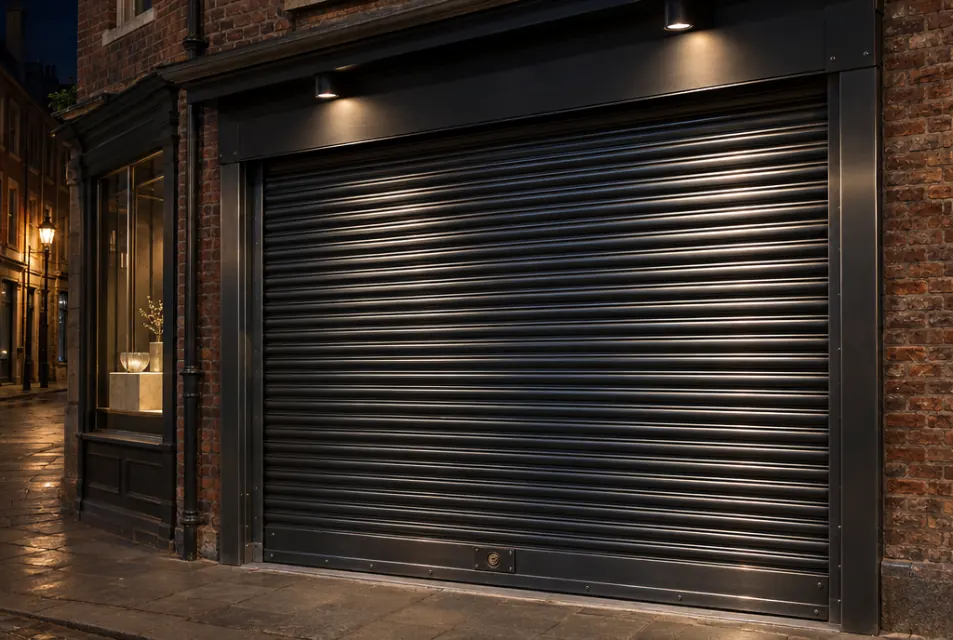
Once closed and locked, it resists forced entry through the shopfront for longer than a standard shutter, buying time, but no shutter is attack-proof, and it does not stop a vehicle or protect a weak rear door or roof.
What is a high-security shutter and how does it differ from a standard roller shutter?
A high-security shutter uses heavier lath, stronger guides, a reinforced bottom rail and better locking than a standard roller shutter. The aim is to slow an attack, so the attacker needs more time and noise to get through. A standard manual or electric shutter is designed to stop casual forced entry.
Where your insurer asks for it, the shutter must be certified to LPS 1175, and we quote for a certified product by name. A certificate covers the product as tested and installed. Ask the manufacturer what the certificate requires of the installer, and check the product on the LPCB Red Book (RedBookLive). If your policy asks for a listed installer, tell us at the start, because that decides whether we can take the job. Read the LPS 1175 guide.
How much do high-security shutters cost?
High-security shutters start from £4,194 inc VAT (£3,495 plus VAT) and run to about £10,794 inc VAT (£8,995 plus VAT) for a typical opening. These are guides until the survey, because the rating, the size and the fixing conditions set the final figure.
| What moves the price | Effect |
|---|---|
| Required rating | A higher tested rating needs heavier components |
| Opening size | Heavier lath and a bigger barrel for larger openings |
| Motor | Any motor is itemised on the quotation |
| Fixing surface | Weak masonry or cladding may need extra preparation |
| Certification route | Keeping to a certified product narrows the options |
See the price guide.
Which spec choices matter on a high-security shutter?
The rating, lath, guides, bottom rail, locking and fixings decide how a high-security shutter performs. The current issue of LPS 1175 gives ratings written like C5 or D10, a toolset letter plus delay minutes. Older issues used SR1 to SR8. Both exist in the field, and the certificate is what matters.
Ask for the exact rating your insurer names and the certificate number of the product. Check it on the LPCB Red Book (RedBookLive) rather than relying on a brochure.
A shutter is only certified as tested. Change the guides, lath or fixing method and the certificate may no longer cover it. The wall behind it counts as well: the strongest curtain is wasted if the fixing surface crumbles. We check the substrate at survey.
What planning and other rules apply to a high-security shutter?
External shutters are commonly treated by councils as a material alteration to how a building looks, so many expect a planning application. The council decides for your site, and a heavy high-security curtain with a deep box can draw closer attention. Work that affects a listed building's character needs listed building consent.
A powered curtain is a powered door at work, so the Workplace (Health, Safety and Welfare) Regulations 1992, BS EN 13241 and BS EN 12453 apply. Fire exits must stay usable from inside under the Fire Safety Order.
Read the planning guide and, for insurer requirements, what insurers want from shutters. Check with your broker before you order. We cannot say a shutter changes your insurance cost.
What happens at the survey and the fitting?
The survey for a new high-security job is free and starts with your insurer's wording. We ask what your insurer requires, look at what you store and how it could be attacked, and check the wall, lintel and floor where the shutter will be fixed. We then agree the rating and components with you.
You receive an itemised written quotation, valid for 90 days, naming the certified product where one is required. Nothing is ordered until you accept it, and installation is booked at a time that suits you.
Fitting follows the manufacturer's method, because a certificate covers the product as tested and installed. Ask to see the certificate, and ask the manufacturer what it requires of the installer. Your contract sits with S&K Glazing Limited, and installers we appoint may carry out the job.
How do you look after a high-security shutter?
A high-security shutter is heavy, so its moving parts see more stress. Keep the guides clear, wipe the curtain down and watch for any rubbing, noise or hesitation. Report damage after an attempted attack, even if the shutter still closes, because a bent guide or damaged lath can weaken it.
Powered units need a regular service and safety check under the Workplace Regulations 1992. The service and safety check is a paid visit at £174 inc VAT (£145 plus VAT) per shutter, and it is not a repair price. Repairs are not fixed-price, and we quote them after inspecting the shutter.
Ask the manufacturer which parts keep the certificate valid, because substitutes can void it. See servicing and repairs.
Which options can you choose?
| Option | What it means |
|---|---|
| Rating | The LPS 1175 rating your insurer names, such as C5 or D10, or an older SR grade. |
| Lath | Heavy interlocking steel lath, sometimes double-skin, chosen to match the certified product. |
| Guides and fixings | Reinforced guides fixed into sound masonry or steel, specified to the product listing. |
| Locking | Heavy bottom rail with multiple lock points; keyed alike if you have several. |
| Operation | Electric, with manual override, because the curtain is heavy. Any motor is itemised on the quotation. |
Common questions
How much does a high-security shutter cost?
High-security shutters start from £4,194 inc VAT (£3,495 plus VAT), with a guide range up to £10,794 inc VAT (£8,995 plus VAT). The required rating, size and fixing conditions set the final figure, and any motor is itemised on the quotation. Your written quotation, issued after the free survey, carries the exact price.
What does LPS 1175 mean?
LPS 1175 is a Loss Prevention Standard that tests how long a product resists attack. The current issue uses ratings such as C5 or D10, and older issues used SR1 to SR8. Check the certificate on the LPCB Red Book (RedBookLive).
Will my insurer insist on a certified shutter?
Some do for certain premises or stock. Ask your broker what they require. Where your insurer asks for it, the shutter must be certified, and we quote for a certified product by name. If your policy asks for a listed installer, tell us at the start, because that decides whether we can take the job. We cannot say a shutter changes your insurance cost.
Can a high-security shutter be broken?
Any shutter can be defeated with enough time and tools. A high-security shutter is built to delay an attack and make it noisy. It does not stop a vehicle, and it does nothing for a weak rear door or roof.
Do high-security shutters need planning permission?
Possibly, if it is external. Many councils expect an application for an external curtain, but yours decides for your site. Internal shutters behind the glass usually need none. Where the work affects a listed building's character, it needs listed building consent, so check with the council first.
Is a high-security shutter noisy to use?
It is heavier than a standard shutter, so the motor and laths make more noise as it moves. Clean guides and regular servicing keep it smooth. The sound of a closing shutter is a normal part of using one.


