
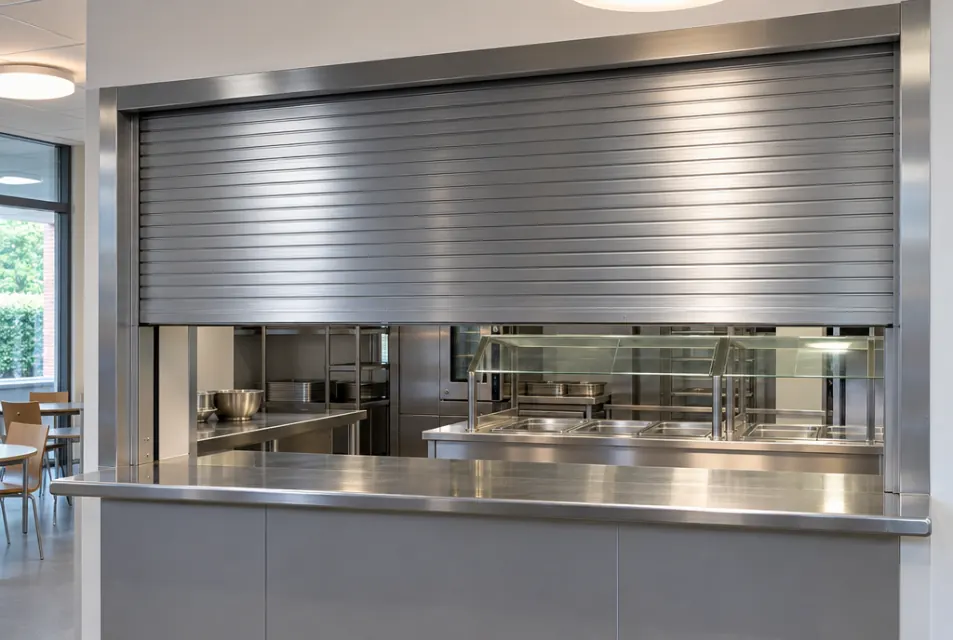
Once closed and locked, it stops access over or through a counter to stock, tills or a service area, but it does not protect the outer glazing or the front door, and it does not stop a determined attack with tools.
What is an internal counter shutter and how does it differ from an external one?
An internal counter shutter is a roller shutter fitted inside the building over a counter, hatch or opening between rooms. It sits behind the glass, out of the weather and out of sight from the street. An external shutter closes the shopfront itself, and is a separate job. See electric roller shutters for the outward-facing type.
Counter shutters are smaller, lighter and often quieter than shopfront curtains. They close a bar when the pub stops serving, seal a pharmacy dispensary when it is closed or shut a hatch while the shop stays open. They are one of the five layers, working at layer 2 inside the building.
How much do internal counter shutters cost?
Internal counter shutters start from £1,980 inc VAT (£1,650 plus VAT) and run to about £3,954 inc VAT (£3,295 plus VAT) for a typical opening. These are guides until the survey, because size, lath, box position and operation change the final figure.
| What moves the price | Effect |
|---|---|
| Opening width and height | More lath and a bigger barrel for larger counters |
| Lath type | Solid, perforated or open pattern are priced differently |
| Manual or electric | A motor or key switch adds to the total |
| Box position | Boxed in, face fixed or recessed into the soffit |
| Locking | Keyed locks or a master-keyed system add cost |
A fitted standard tubular motor up to 100Nm is £474 inc VAT (£395 plus VAT). See the price guide.
Which spec choices matter on a counter shutter?
Lath type, box position, guides, locking and operation decide how a counter shutter works in daily use. Solid lath blocks the view and gives the most metal. Perforated or open-pattern lath lets staff and customers see through, which suits a hatch where people talk through the opening.
The box can be face fixed, boxed into a bulkhead or recessed above the opening. Space above the counter decides which fits. Guides run down the sides, and the bottom rail should meet the counter top squarely with a lock at one or both ends.
Operation is by hand for light use or by motor for a wide bar. Staff who lower it many times a shift will thank you for the motor. Keep the key control away from customers, and ask us about a master-keyed set if you have several shutters.
Does an internal counter shutter need planning permission?
Internal shutters behind the glass usually do not need planning permission, because they do not change how the building looks from outside. That is the usual position, and your council decides for your site. Internal work that affects a listed building's character needs listed building consent, so check.
Other rules can still apply. If your lease limits alterations, ask the landlord. A licensed premises may have layout conditions in its licence, so check with the licensing authority before you change a bar. Fire exits must stay usable, and a shutter must not block an escape route.
A powered counter shutter in a workplace is a powered door, covered by the Workplace (Health, Safety and Welfare) Regulations 1992. See the planning guide.
What happens at the survey and the fitting?
The survey is free where the shutter is a new installation. We measure the counter or hatch, check the soffit, bulkhead and sides, and see where a box and a lock can go. We also ask how staff and customers use the space, so the shutter fits the routine.
After that you receive an itemised written quotation that stays valid for 90 days. Nothing is ordered until you accept it, and installation is booked at a time that suits your trading hours, so the counter is not out of use during the day.
At fitting, the guides and box go in, the curtain is hung and the locks are set. If it is electric, the supply is wired in and the key switch tested. The contract is held by S&K Glazing Limited, and the fitting may be done by installers we appoint working under it.
How do you look after an internal counter shutter?
Internal shutters get less weather but more handling. Keep the guides clear of crumbs, spilt drink and dust, wipe the curtain down and keep the counter top free of anything that stops the bottom rail seating.
Behind a bar, sticky residue in the guides is the usual cause of drag. Watch for noise, a curtain that creeps to one side or a lock that no longer turns smoothly. Do not force it.
Booking a service is a paid visit at £174 inc VAT (£145 plus VAT) per shutter, and it is the check only, not a repair. Repairs are quoted after inspection. See shutter repairs if yours is damaged or jammed.
Which options can you choose?
| Option | What it means |
|---|---|
| Lath type | Solid for full cover, or perforated and open pattern when staff need to see through. |
| Box position | Face fixed, boxed into a bulkhead, or recessed above the opening. |
| Operation | By hand, or electric with a key switch or push button behind the counter. |
| Locking | Bottom rail lock at one or both ends; keyed alike or master-keyed. |
| Finish | Mill finish or powder coating to match the interior. |
Common questions
How much does an internal counter shutter cost?
Internal counter shutters start from £1,980 inc VAT (£1,650 plus VAT), with a guide range up to £3,954 inc VAT (£3,295 plus VAT). Size, lath, box position and operation set the final figure. A free survey comes first, then an itemised written quotation with the exact price.
Do I need planning permission for an internal shutter?
Usually not, because it sits behind the glass and does not change how the building looks. Your council decides for your site. Listed buildings can need consent, and a lease or premises licence may add conditions.
Can a counter shutter be electric?
Yes. A key switch or push button behind the counter lets staff lower and raise it without lifting. A fitted standard motor up to 100Nm is £474 inc VAT (£395 plus VAT). Add a manual override for power cuts.
Will it protect my shop window and door?
No. An internal counter shutter protects what is behind the counter, not the outer glazing or front door. If you need the frontage covered as well, we quote an external shutter or grille alongside it.
Can staff see through a counter shutter?
Only if you choose perforated or open-pattern lath. Solid lath blocks the view. Many hatches use an open pattern so people can talk through the opening. We discuss which suits your counter at survey.
Is a counter shutter noisy?
It makes some noise as the laths coil, and a motor adds a low hum. Clean, dry guides keep it down. In a quiet room, ask about the box position and lath type, since both affect the sound.


