
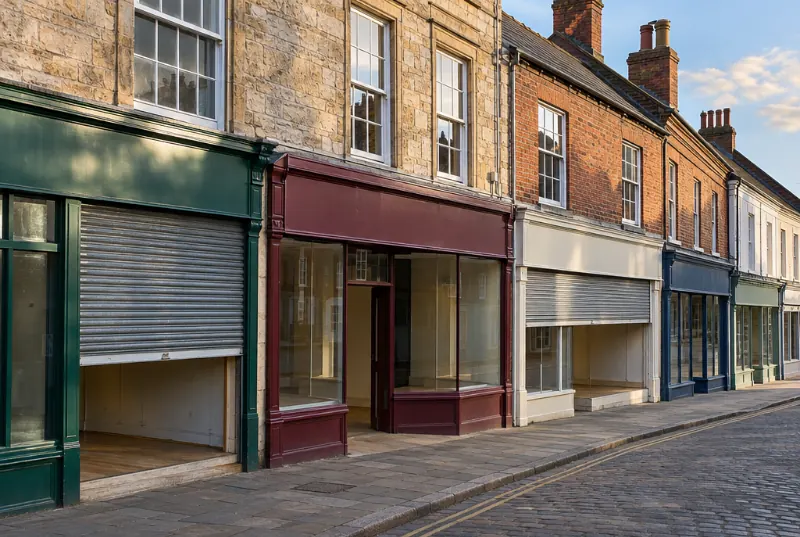
Shops are usually attacked at the glass, the entrance door or the rear service door, because those are the quickest and quietest points to defeat. Smash and grab raids depend on speed, and ram raids depend on a vehicle reaching the frontage. Visible stock and a lit till area make both more tempting.
What usually suits this kind of premises, layer by layer?
| Layer | What usually suits |
|---|---|
| Bollards and barriers | Add them where a vehicle can reach the glass from a car park or forecourt. Standard steel bollards stop parking and clipping. Crash-rated ones suit places where a deliberate impact is a realistic risk. |
| Shutter or grille | A perforated or solid roller shutter outside the glass suits most high street units. Choose perforated to keep the display visible at night, and solid where stock is tempting and the council allows it. |
| Glazing and frame | Laminated glass holds together after repeated blows, which toughened glass does not. Strong frames and fixings matter just as much, because a weak frame lets the whole pane be levered out. |
| Doors and locks | Once the glass holds, the entrance and rear doors become the way in. Use multipoint locking on the entrance, a reinforced rear door and hinges that cannot be lifted off. |
| Access control | Keypads or fob readers on staff and rear doors cut shared keys and let you withdraw access when someone leaves. Any control on an exit route must release from inside and on the fire alarm. |
What shutter suits a shop on the high street?
A roller shutter fitted outside the glass suits most high street shops, and the choice between perforated and solid depends on what you want seen at night and what the council will accept. Perforated shutters let light and display show through. High security shutters suit units holding stock that attracts organised theft. Internal counter shutters protect a till area without changing the outside of the building.
Whichever you choose, the guides need to be fixed to sound reveals and the shutter must close onto a solid sill. External shutters usually need planning permission, and the council decides, so we raise that at the survey rather than after the order.
How do thieves usually get into a shop that is closed?
Most closed shops are entered through the glass, the front door or the back door, usually in that order of speed. Glass is attacked with a hammer, a brick or a bar, and the aim is to reach stock within seconds. Front doors fail at the lock or the frame rather than the door leaf. Rear doors fail because they were never specified for attack in the first place.
Our survey follows that order. We look at the frontage from the street, then walk the building to the rear, and note what each opening is made of, what it is fixed to and who can reach it. The quotation then lists each layer as a separate item, so you can see what each one is for. There is more detail in our smash and grab guide and our rear door guide.
Where should a retailer start when the budget is limited?
Start with the weakest point on the frontage, which is usually the glass or the rear door, and add the other layers as budget allows. A single strong shutter in front of weak glazing and a weak door only moves the attack somewhere else. A planned order of work avoids paying twice.
Our itemised quotation separates each layer, so you can phase the work and see what is left to do. Prices are guides until the survey; for example, a manual roller shutter starts from £1,068 inc VAT (£890 plus VAT). You can work through the shop security checklist first, then ask for a written quotation. Nothing is ordered until you accept it.
Common questions
Does a retail shop need a roller shutter?
No law requires one, but most shops with glass at street level choose a shutter or grille because glass is the quickest way in. Your insurer may have its own conditions, so ask your broker before you decide what to buy.
Can customers still see my window display at night?
Yes, if you choose a perforated shutter or an open-link grille. Both let light and display show through while still protecting the glass. A solid shutter hides the window completely, which suits some stock but not others.
Will my insurer ask for a particular shutter?
Some do. Where your insurer asks for a certified shutter, the certificate must match the rating they name, and we quote for a certified product by name. Ask your broker for the requirement in writing before we survey.
Do I need my landlord's permission to fit a shutter?
Usually yes. Most leases restrict changes to the frontage, and a shutter changes how the building looks. Check your lease and ask your landlord before you order. The council decides on planning separately. Doing this first avoids paying for a shutter you cannot fit.


