
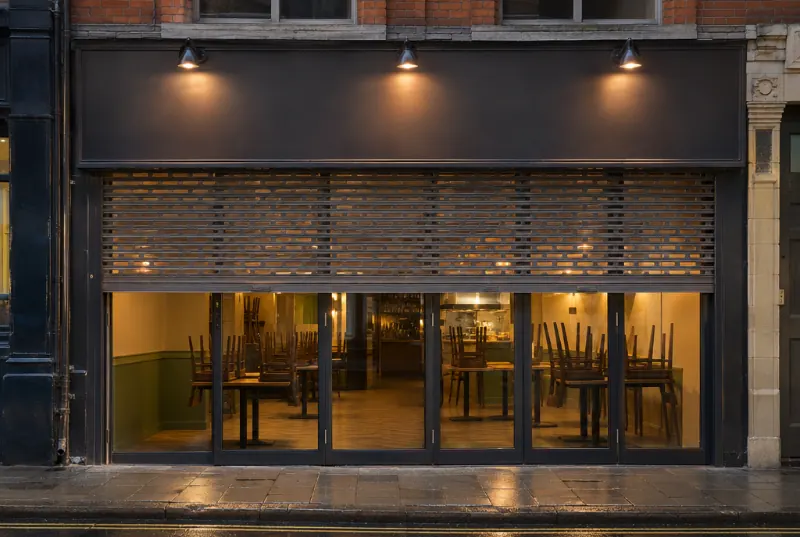
Restaurants, cafes and takeaways are often attacked at the rear door, the kitchen window or the front glass, because cash, tills and expensive kitchen equipment are inside. Rear alleys give cover, and bins are sometimes used to climb. Premises with a flat roof or a first-floor flat above can be entered from above.
What usually suits this kind of premises, layer by layer?
| Layer | What usually suits |
|---|---|
| Bollards and barriers | Worth considering where seating spills onto a pavement or a car can reach the glass. Removable bollards can protect an outdoor area while leaving it clear for trade, subject to highway permission. |
| Shutter or grille | Perforated shutters keep an open look on a street frontage. A solid shutter suits the rear and side windows. Check clearance for extraction ducting and signs before the shutter size is fixed. |
| Glazing and frame | Laminated glass on the front and any low rear window resists the quick smash. Frames should carry the weight of the glass and any shutter without twisting, which cheap frames often do. |
| Doors and locks | Kitchen and yard doors take the most abuse. A steel-faced or reinforced door with multipoint locks and protected hinges lasts longer. Fire exits must still open from inside without a key. |
| Access control | A keypad or fob reader on the staff door replaces keys that go missing when staff leave. A record of who entered can help after an incident, and these records can be personal data. |
Which part of a restaurant is most at risk when it is closed?
The rear door and the kitchen window are usually the most exposed parts, because they sit out of sight of the street. Front glass is the second target, mainly where a till or a tip jar is visible. Anything that gives a thief cover, such as a gated alley, a flat roof or stacked bins, makes the rear more attractive.
Our survey starts at the back for that reason. We note what the rear door is made of, how it is locked, whether the window can be reached from a bin or a wall, and where the lighting falls. The front shutter and glazing are then planned to match the standard of the rear, so there is no obviously weak side. See the rear door security guide for the detail.
Can a shutter be fitted with extraction ducts and a shopfront sign?
Yes, but the ducts, signs and awnings must be measured before the shutter is made, because they decide the box size and the guide positions. A shutter that is built from a rough sketch often clashes with a sign or a flue. We record each fixture at the survey and show how the shutter clears them in the quotation.
Hot work and flues need space around them, so we keep the shutter and its box away from heat sources. If the frontage carries an illuminated sign, advertisement consent is a separate matter from planning for the shutter, and the council decides on both. A perforated roller shutter is a common choice for food premises because it keeps the shop looking open.
How do I secure a takeaway that trades after dark?
Plan for two states: open and closed. When open, the risk is people at the counter, so many takeaways use an internal counter shutter or a screen to protect the till, and keep cash out of reach. When closed, the risk is the building, which needs the shutter, glazing and doors described above.
An internal counter shutter closes over the serving hatch or counter while the rest of the premises stays in use for cleaning and prep. Access control on the staff door means closing staff can leave without sharing keys. Fire exits must stay usable from inside at all times. We write the layers into one itemised quotation so you can see what each part costs.
Common questions
Do takeaways need a shutter on the front?
Not by law, but most have one because the glass and till are exposed overnight. A perforated shutter keeps the shop looking open, while an internal counter shutter protects the serving area when you close early.
Can I fit a shutter over a window with a flue or sign?
Yes, if the flue and sign are measured first. We record every fixture at the survey, size the box and guides to clear them, and keep the shutter away from heat. Advertisement consent for a sign is separate.
What door suits a restaurant kitchen exit?
A reinforced door with multipoint locking and protected hinges suits most kitchen exits. It must open from inside without a key at all times, because a kitchen door is often part of the escape route.
Can access control replace keys for kitchen staff?
Yes. A keypad or fob reader lets you issue and withdraw access without changing locks. On any fire exit it must release on the alarm and open from inside, and its records may be personal data.


