
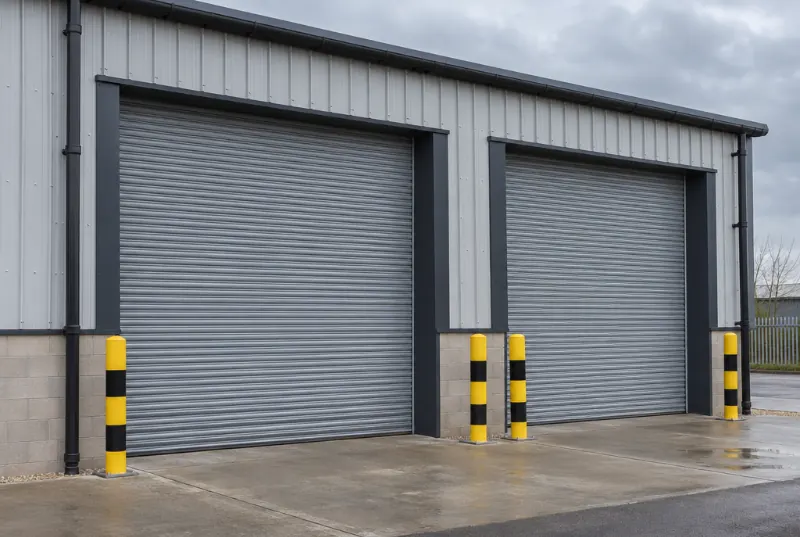
Warehouses and industrial units are usually attacked at loading doors, roller doors, side access doors and roof lights, often after the yard has been entered by cutting a fence or following a delivery vehicle. Large openings are vulnerable because they rely on one lock or one motor. Yards behind fencing give thieves time and cover.
What usually suits this kind of premises, layer by layer?
| Layer | What usually suits |
|---|---|
| Bollards and barriers | Place bollards at door jambs and corners to protect against fork lift and lorry impact, and at pedestrian doors that open onto yards. Specify crash-rated barriers only where hostile vehicle risk is real. |
| Shutter or grille | Insulated or high security roller shutters suit loading doors. Fit end locks or a bottom rail lock suited to the opening, and size the motor for the curtain weight and the number of daily cycles. |
| Glazing and frame | Office glazing and vision panels on the unit frontage should be laminated, with roof lights and low windows covered by grilles. Frames need fixings into sound structure, not thin cladding. |
| Doors and locks | Steel personnel doors with multipoint locks and protected hinges suit side and rear access. Fire doors must stay usable from inside, and locks must never stop them opening from inside in an emergency. |
| Access control | Fob or keypad control on pedestrian doors and vehicle gates shows who entered and when. Where a door is on a fire route, it must release on the alarm and open from inside. |
What shutter suits a loading bay or industrial door?
A powered roller shutter built for the opening size and daily use suits most loading bays. Large openings carry heavy curtains, so the barrel, springs and motor must be sized together. An undersized motor wears out quickly and a poorly balanced curtain strains the guides.
Insulated shutters suit heated units where heat loss matters, and high security shutters suit stores holding stock that attracts organised theft. Powered doors in workplaces fall under the Workplace (Health, Safety and Welfare) Regulations 1992, which cover powered doors and their maintenance. The product standard is BS EN 13241 and safety in use is covered by BS EN 12453. The motor is included in electric shutter prices. A heavier motor than our standard 100Nm unit is itemised on the quotation.
How do you protect an industrial unit from a break-in at night?
Treat the unit as a set of openings and secure each one to the same standard, because thieves look for the weakest. The loading door, the personnel door, the roof lights, the office window and the yard gate all need a view. Perimeter fencing and lighting help, but the building itself should not rely on them.
Our survey walks the whole unit and the yard and lists each opening with a recommendation. The quotation shows each layer as a separate item. Many units add access control to pedestrian doors so keys are not shared between contractors, and bollards at vehicle doors. Insurers often set their own rules, so ask your broker what applies to your policy. Our insurer guide explains the common terms.
Do fire shutters suit a warehouse or industrial building?
Fire shutters suit openings in fire-resisting walls, such as a door between a warehouse and an office or between two compartments. They are tested to BS EN 1634-1, or to BS 476-22 on many existing products, and the resistance is given in minutes, such as E 60 or E 120. Approved Document B stops recognising BS 476 fire resistance classes for new work from 2 September 2029, subject to transitional rules, so ask for the BS EN classification on anything new.
A fire shutter closes by gravity or a controlled device when an alarm or fusible link triggers it. It does not normally stop radiant heat unless it is insulated, so the rating must be matched to what the wall needs. A W in the rating, as in EW 60, limits radiant heat, and an I, as in EI 60, adds insulation. The responsible person has duties under the Regulatory Reform (Fire Safety) Order 2005, and a fire risk assessment should confirm the requirement. See fire-rated shutters and our fire shutter guide.
Common questions
How should a loading bay door be secured?
Use a roller shutter or sectional door sized for the opening, with locks suited to the exposure, and protect the jambs with bollards. Powered doors need a safety edge and photocells so they stop on contact.
Do industrial units need planning permission for roller shutters?
External changes to a building can need planning permission, though industrial estates are often more relaxed than shopping streets. The council decides, so ask before ordering, and check your lease or your landlord's rules first.
Can a warehouse door be made fire rated?
Yes. A fire shutter or fire door can be fitted in a rated wall, with resistance given in minutes. It must be tested to the right standard for the opening, and a fire risk assessment should confirm what is needed.
How often should an industrial shutter be serviced?
Usually once a year, or more often for doors used many times a day. Powered doors in workplaces must be maintained under the Workplace Regulations 1992. Servicing is a paid visit, and we agree the date with you first.


