
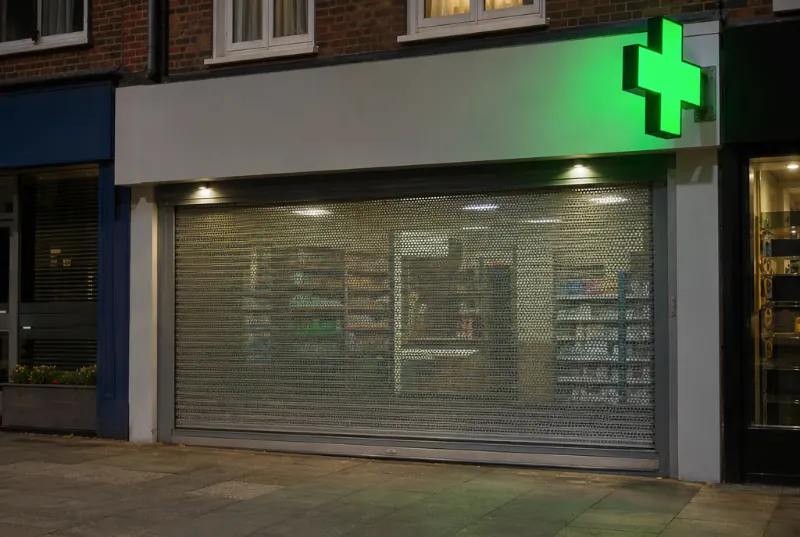
Pharmacies are usually attacked at the rear door, the dispensary window or the front glass, because medicines and cash are inside. Quiet back lanes and service yards give cover. Surgeries and clinics are attacked for equipment and drugs, often through poorly protected rear or side doors.
What usually suits this kind of premises, layer by layer?
| Layer | What usually suits |
|---|---|
| Bollards and barriers | Useful at a pharmacy next to a road or car park where a vehicle could reach the glass. Allow for patient access, wheelchairs and deliveries when you plan their positions. |
| Shutter or grille | A shutter on the front and any dispensary window, and a grille or shutter on side and rear openings, covers the usual points of attack. Perforated types keep the shop looking open and lit. |
| Glazing and frame | Laminated glass in the shopfront and dispensary resists the quick smash. The frame must be strong enough to hold it, and level thresholds and wide doors support patient access. |
| Doors and locks | Rear and staff doors need reinforced leaves, multipoint locks and protected hinges. Fire exits must open from inside, and entrances need to meet access requirements for disabled people. |
| Access control | Controlled entry to the dispensary, stockroom and staff areas limits who can reach medicines and records. Records can be personal data. Release on the fire alarm is required on escape routes. |
How is a pharmacy protected when it is closed?
A closed pharmacy needs the front glass, the dispensary and the rear door secured to a matching standard, because thieves go for the weakest of the three. The front is protected by a shutter and laminated glazing, and the rear by a reinforced door and, where there are low windows, grilles.
Cabinet and storage requirements for medicines are set by separate rules and are not part of frontage work, so we do not advise on them. Our survey looks at the frontage and every opening, then lists each layer as a separate item in the quotation. A perforated shutter keeps the shop looking open, and a security door suits the rear. See the rear door guide.
How do you keep a clinic accessible while keeping it secure?
Keep the public entrance accessible and put the security on the parts that matter when the building is closed, so nobody has to choose between access and protection. A level threshold, a wide door and automatic opening can sit alongside laminated glass, a shutter that retracts fully and an access-controlled staff entrance.
Entrances should meet Approved Document M, which covers access to and use of buildings, and the Equality Act 2010 places duties on service providers about reasonable adjustments. We cannot confirm that a design meets those duties for your site, so check with your own adviser. Automatic opening can be linked to the door lock, and the system must always release on fire. See entrance doors.
Should a pharmacy have access control on the dispensary?
It is a sensible control, because it limits who can enter the dispensary and records entry when needed. A keypad or fob reader on the dispensary door means staff do not share a key and access can be withdrawn as soon as someone leaves.
Entry records can be personal data, so set a clear purpose and keep them no longer than needed. The reader must not trap anyone: a door on an escape route must open from inside and release on the fire alarm. The control sits with other layers, so the survey also checks the front glass, the shutter and the rear door. Our access control page explains the parts, and the prices page shows guide prices.
Common questions
Do pharmacies need roller shutters?
Many fit them because medicines and cash make the premises a target. A shutter is not a legal requirement, but it adds a strong layer in front of the glass. Ask your broker whether your policy sets any conditions.
Can a pharmacy shutter keep the window lit?
Yes. A perforated shutter or open-link grille lets the window light show through at night, so the pharmacy still looks occupied. It protects the glass while keeping the frontage open and lit for passers-by after you close.
How should a surgery rear door be secured?
Use a reinforced door with multipoint locking and protected hinges, and add lighting and a lockable gate if there is a yard. The door must open from inside without a key in an emergency, so check the escape route.
Does a medical premises need disabled-access doors?
Entrances should support disabled access under Approved Document M and the Equality Act 2010. We can fit wide doors, level thresholds and automatic opening, but please confirm your duties for your premises with a qualified adviser.


